Welcome to Fresh Focus AI
A fast, practical AI workspace for research, writing, and automation.
Getting Started
Pricing and Subscription
Fresh Focus AI is available for $15 per month.
- 1-week free trial: Start using the service without paying for the first 7 days.
- Credit card required: A valid credit card is needed to begin your free trial.
- Cancel anytime: You can cancel your subscription at any time before the trial ends to avoid charges.
No hidden fees—your subscription will be billed monthly after the trial period.
1. Create an account (or log in)
- Visit https://freshfocusai.com.
- Click Log in and follow the simple sign-up process.
- You can authenticate using Google (recommended for easy sharing) or other social logins like Amazon or Facebook.
- Alternatively, you can create an account using your email and password.
- Confirm your email and log in to get started!
2. Choose your first model
The AI tab opens with OpenAI GPT-5-mini pre-selected – a fast, balanced default for reasoning-heavy prompts.
You can switch to any provider via the AI Model Selector dropdown.
Quick picks
- Latest flagship (reasoning + agents): OpenAI GPT-5 → best for coding, tool-rich tasks, agent flows.
- Google’s newest multimodal (1M ctx): Gemini 2.5 Pro → deep multimodal analysis; Flash / Flash-Lite → speed/price.
- Math/logic deep-think: OpenAI o-series (o3 / o4-mini).
- Polished writing + analysis: Anthropic Claude 4.0 Opus.
- Cost-efficient open options: DeepSeek R1 (Reasoner) / DeepSeek Chat.
- RAG-centric pipelines: Cohere Command-R / R+.
- Creative with X integration: xAI Grok family.
Model selector overview
| Model family | Best for | Notes |
|---|---|---|
| OpenAI GPT-5 / GPT-5-mini / GPT-5-nano | Coding, agentic tasks, tool calling | Supports reasoning_effort and verbosity; strong long-context retrieval; custom tools. |
| OpenAI o3 / o4-mini | Deep multi-step reasoning, STEM | Text-first; spend more “think time” for correctness. |
| OpenAI GPT-4.1 / 4.1-mini / 4.1-nano | General purpose | Solid accuracy; good tool use; vision on select endpoints. |
| OpenAI GPT-4o / 4o-mini | Multimodal UX, screenshots/diagrams | Text+image inputs; balanced quality/speed. |
| Google Gemini 2.5 Pro | Advanced multimodal reasoning | 1M-token context; inputs: text, code, images, audio, video; strong with Google tools. |
| Google Gemini 2.5 Flash | Best price/performance | Also 1M context; “thinking” capability; great for interactive apps. |
| Google Gemini 2.5 Flash-Lite | Lowest latency & cost | 1M context; “thinking” at adjustable budgets; preview/live variants may differ. |
| Anthropic Claude 4.0 Opus | High-quality analysis & writing | 200K context; strong instruction following; safe defaults. |
| DeepSeek R1 (Reasoner) / DeepSeek Chat | Transparent reasoning / fast chat | Open models; good math/coding; cost-effective. |
| Cohere Command-R / R+ | RAG & structured outputs | 128K context; focused on retrieval-heavy workflows. |
| xAI Grok (3/4) | Edgy creativity, real-time X data | Useful for social-data use cases; evolving alignment style. |
3. Ask your first question
“Summarize today’s biggest tech headline in <60 words and explain why it matters.”
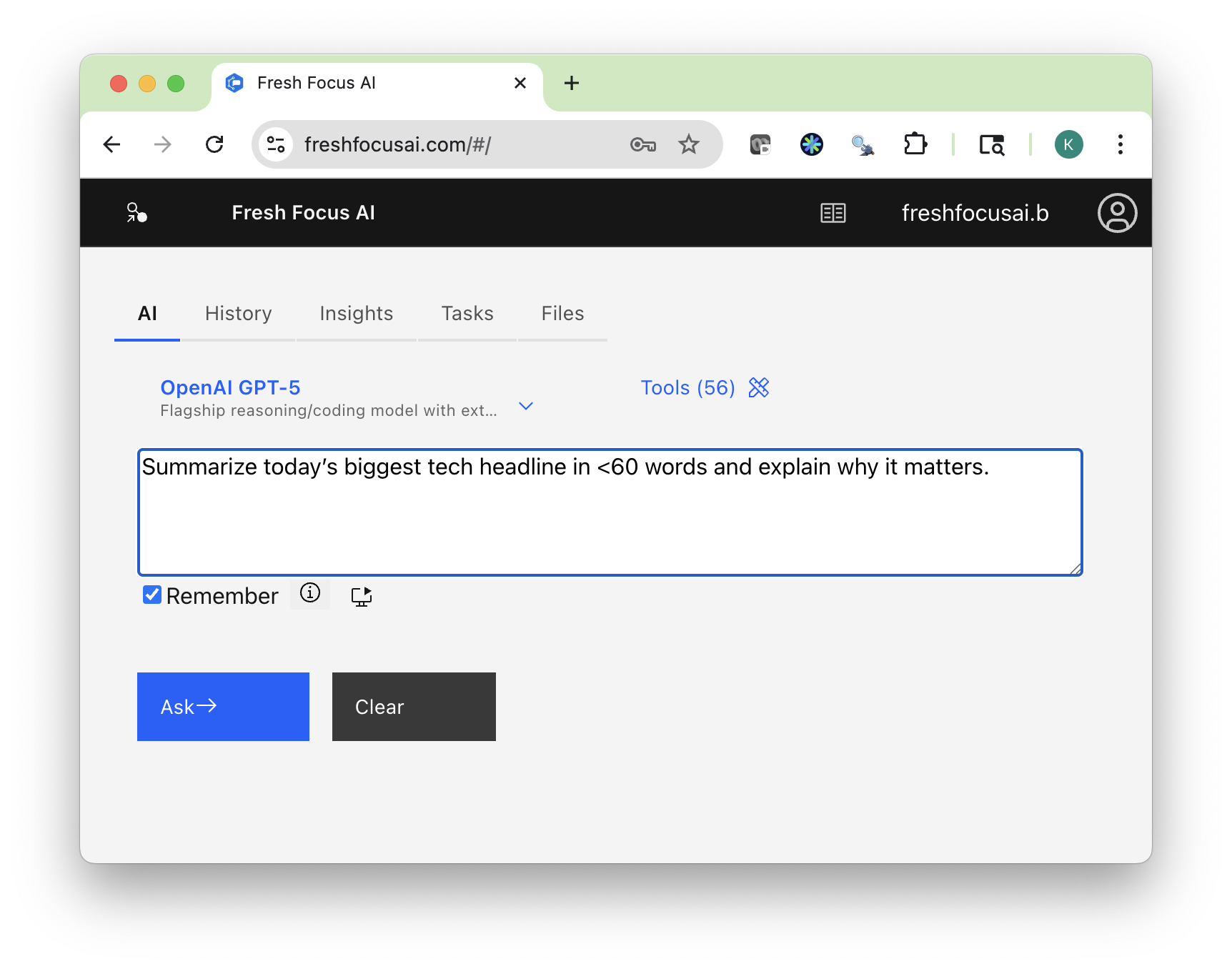
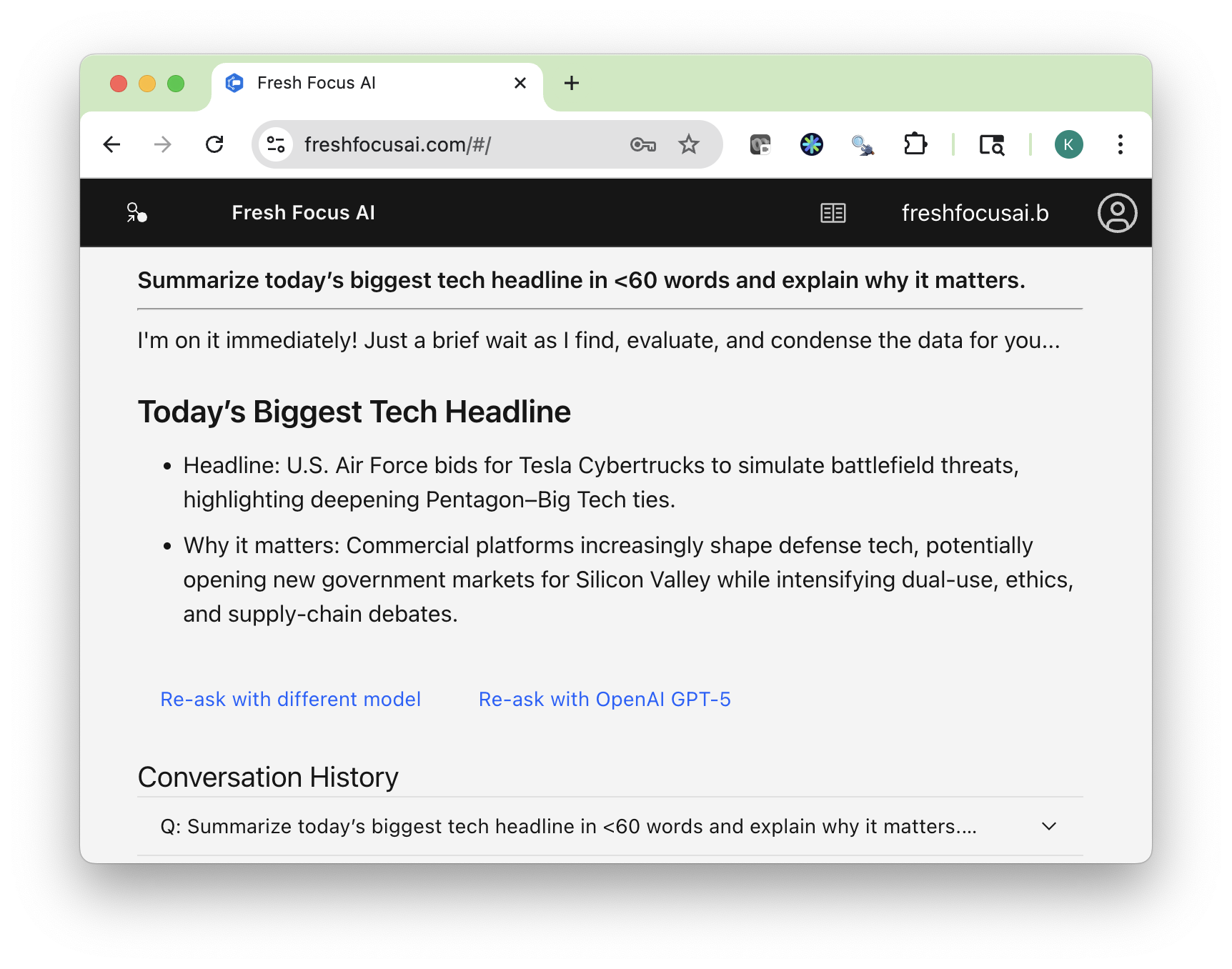
Fresh Focus will pick the best tools automatically (e.g., search + citations), call the selected model, then present an answer.
4. Explore
- AI Tab
- History Tab – resume or compare past chats.
- Insights Tab – auto-generated suggestions based on your activity.
- Tasks Tab – build multi-step or scheduled jobs.
- Files Tab – upload docs for instant analysis.
- Integrations – upload docs for instant analysis.
Ready to go deeper? Continue to Features →
Model Guidance (how to get great answers)
General tips
- Be specific: Include format, length, and audience (e.g., “bullet list, ≤150 words, PM audience”).
- Give examples: Paste a short sample of the voice/style you want.
- Use structure: Ask for JSON or a table when you’ll parse the output.
- Nudge reasoning: For hard tasks, add “show working privately; verify steps before final answer.”
- Chunk long inputs: 1M-token models can read a lot, but smaller chunks + summaries are still faster/cheaper.
When to use which model
- OpenAI GPT-5 (flagship).
Use when you need the strongest coding & agentic performance and precise tool orchestration.
Hints: - Set
reasoning_effort=minimalfor quick takes; increase to improve reliability on tricky tasks. - Set
verbosity=low|medium|highto control how chatty answers are. -
Consider custom tools when you don’t want JSON schemas.
-
Gemini 2.5 (Google).
Use for multimodal prompts (mix text + code + images + audio + video) and 1M-token contexts.
Hints: - For speed/cost: Flash / Flash-Lite. For hardest problems: Pro.
- Turn on Thinking when you want extra deliberation.
-
Pair with Grounding with Google Search for fresher answers.
-
OpenAI o-series (o3 / o4-mini).
Use when you need visible improvement from extra “thinking” time in math/logic/step-by-step tasks. -
Claude 4.0 Opus (Anthropic).
Use for long analyses, careful writing, and safer defaults. Good at following constraints. -
DeepSeek R1 / Chat.
R1 emphasizes explicit reasoning traces (API). Chat is faster for general conversation/coding. -
Cohere Command-R / R+.
Best slotted into RAG pipelines that need long context + clean, structured outputs.